Martian lifespan and age for the thousand-year pilgrimage
A Princess of MarsMartian lifespan and age for the thousand-year pilgrimage describes a society in which remarkable longevity coexists with an early, violent death for most inhabitants. At about one thousand years old, some Martians voluntarily embark on a final journey down the River Iss; for everyone else, duels, hunting, aviation, war, and childhood mortality sharply reduce the years they are likely to live.
Longevity and the Final Pilgrimage
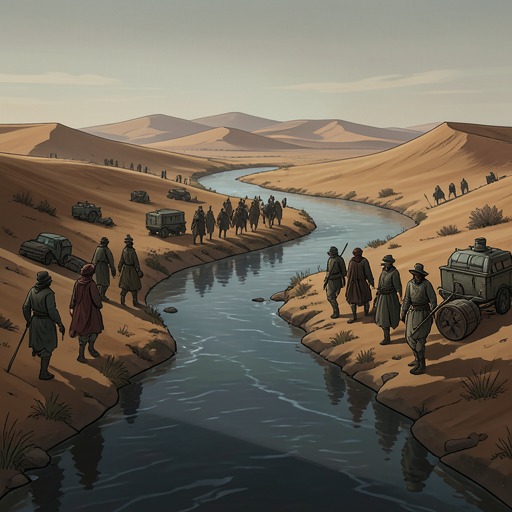
Martians show little visible sign of extreme age, and their appearance changes little between maturity, reached at about forty, and the age of roughly one thousand, when they may undertake the last pilgrimage down the River Iss. The journey is presented as both voluntary and irreversible: no living Martian knows where the river leads, and no one who embarks returns. The account makes a thousand years an age of departure rather than an ordinary endpoint of old age.
The pilgrimage is uncommon. About twenty in every thousand Martians are estimated to take it, while the overwhelming majority die earlier. The distinction is not simply between long and short lives: the journey is a recognized choice available to the very old, set against a society in which most deaths come through other causes.
Mortality and Life Expectancy
Only about one Martian in a thousand is said to die of sickness or disease. The account instead estimates that 979 in every thousand die violently, through duels, hunting, aviation, and war. The listed causes make violence part of ordinary life across several settings, rather than an exceptional danger confined to warfare.
Childhood is a major source of mortality as well. Vast numbers of young Martians fall victim to the great white apes of Mars, making the risks of life begin long before maturity. This early toll sits alongside the dangers faced by adults and helps explain why a population capable of living for centuries does not commonly do so.
After maturity, the average life expectancy is about three hundred years. The narrator estimates that it would approach one thousand were it not for the many routes to violent death. The distance between that potential lifespan and the actual average reveals how thoroughly danger limits longevity on Mars.
Declining Resources and the Cost of Survival
The account connects this mortality pattern to the planet’s waning resources. Martian skill in therapeutics and surgery has produced increasing longevity, but the narrative suggests that a longer-lived population became difficult to sustain as resources declined. In this context, life is treated lightly, as reflected in dangerous sports and almost continual warfare among communities.
That explanation places lifespan within a wider social and environmental pressure: medical ability can extend life, but it cannot by itself secure a long life in a world where resources are diminishing and violent risks remain pervasive. The thousand-year pilgrimage stands at the far end of that pressure, a chosen final passage reached by relatively few, while the much larger share of lives ends through violence or in childhood.